Yes, the Grow Light Science ProGrow 1800 is a solid buy for a 4x4 flowering space or a 5x5 veg tent, as long as you're okay with a large fixture footprint and don't need built-in UV or far-red diodes. It draws 673W, pushes 1,821 µmol/s of PPF at 2.7 µmol/J efficacy, and delivers a well-measured 1,182 µmol/m²/s average PPFD over a 4x4 at 18 inches. For most hobbyist growers running one tent, that's more than enough light to drive serious flower production. But there are a few things to know before you pull the trigger, and that's what this review covers. grow light reviews 2021. grow light reviews 2020
Grow Light Science ProGrow 1800 Review: Worth It for You?

Marcus Caldwell
24 Mar 2026
What the ProGrow 1800 actually is
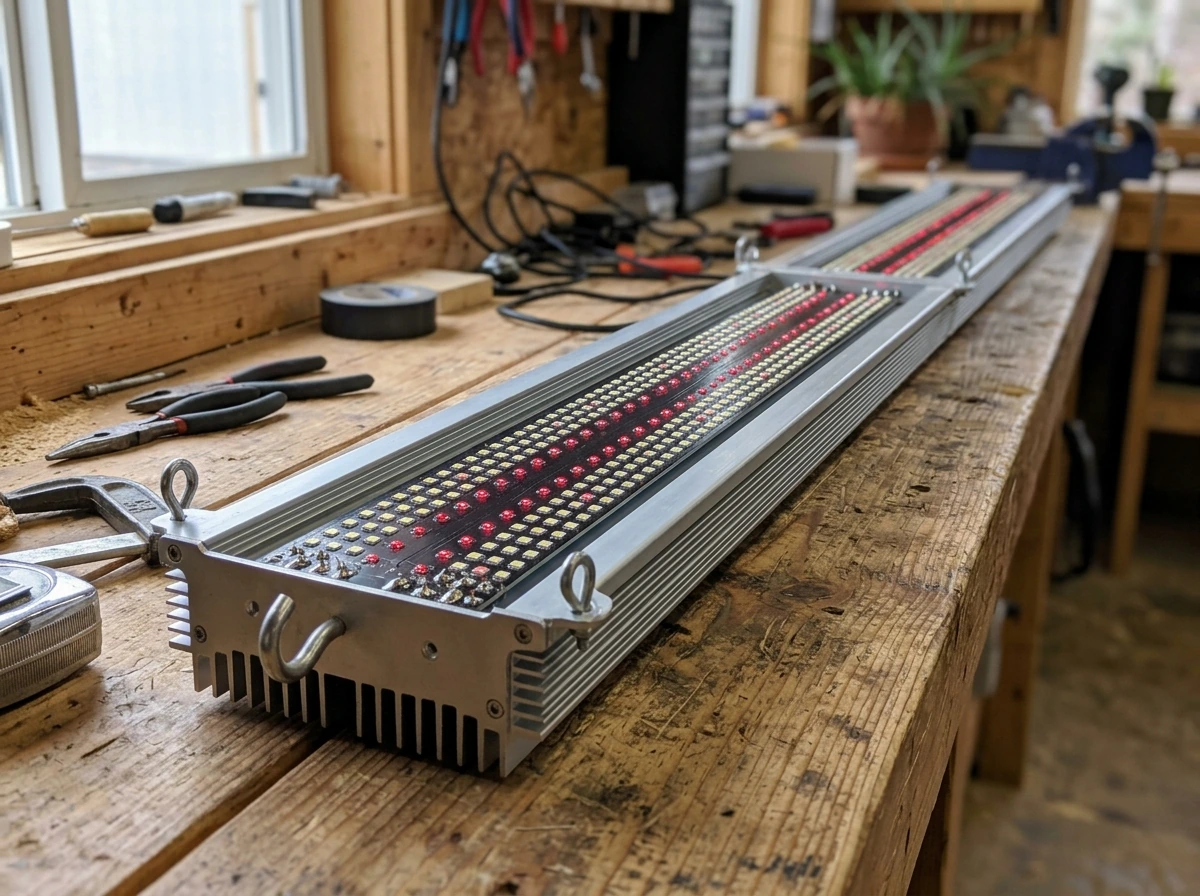
The ProGrow 1800 is a commercial-style LED bar light from Grow Light Science, a brand that sits in the mid-to-upper tier of the hobbyist and small-scale commercial market. It's positioned as a single-fixture solution for a 4x4 flowering canopy or a 5x5 vegetative canopy. The '1800' in the name refers to its approximate PPF output (1,821 µmol/s), not a wattage claim, which is worth noting because some buyers assume it draws 1800W. It actually draws 673W from the wall, which puts it in the same wattage class as other serious single-tent fixtures like the Fluence SPYDR 2i or the Gavita Pro 1700e LED.
It's designed for all plant stages, from seedling through flowering, with the manufacturer publishing specific hanging height and PPFD targets for each stage. It's not a beginner's first grow light at this price point, but it's absolutely appropriate for a hobbyist who wants one light that can carry a tent through a full grow cycle without needing to swap fixtures or supplement with additional bars.
Unboxing and build quality
The ProGrow 1800 ships as a large fixture: 47 inches wide by 42.75 inches deep and about 3.2 inches thick, weighing 23.2 lbs. That's a big footprint, and you need to plan your tent space and hanging hardware accordingly. It won't fit comfortably inside a 4x4 tent on a standard rail system without some adjustment, because the fixture itself is nearly as wide as the tent opening. Most people end up mounting it from the tent's corner anchor points or using external hanging rails.
The box includes ratchet hangers and two types of metal hangers, which is a nice touch since most competitors include only one style. Build quality is genuinely good. The bar construction feels solid, connections are tight, and the driver housing shows no flex or cheap-feeling seams. The IP65 wet rating is a real spec here, not marketing fluff, which means the fixture can handle humid grow room environments without concern about moisture ingress at the diode or driver level.
One practical note: the driver can be remote mounted using an optional 10-foot DC extension cord. If you're in a tight tent, this is worth buying separately, because pulling the driver outside the tent helps with heat management and keeps the internal canopy temperature more predictable.
On the reliability front, there's a reported pattern from at least one user on Reddit where the driver died twice within the first hour on two separate units, with replacement drivers provided by the seller. It's a small sample and could reflect a power quality issue at the outlet rather than a systemic defect, but it's worth plugging the ProGrow 1800 directly into a clean circuit (not through an aging surge strip) and testing it on the bench before mounting it in a sealed tent.
Light output: what the PPFD numbers actually mean
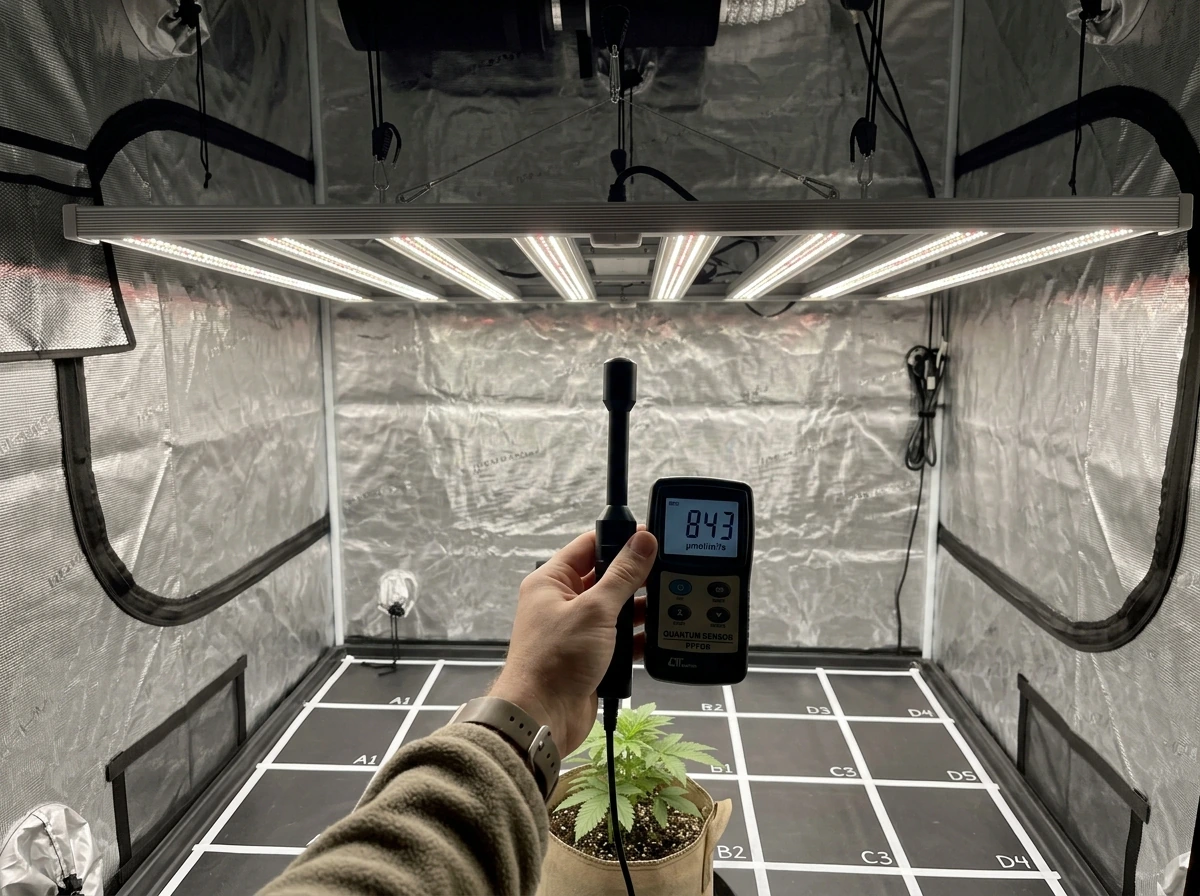
PPFD (photosynthetic photon flux density) tells you how much usable light is landing on your canopy per square meter per second, measured in µmol/m²/s. It's the number that actually determines whether your plants can photosynthesize efficiently at a given canopy position. PPF (photosynthetic photon flux, measured in µmol/s) is the total light output from the fixture before any is lost to walls, distance, or reflectivity. The ProGrow 1800's 1,821 µmol/s PPF is the total output; the PPFD numbers are what you actually get at the canopy.
At 18 inches of hanging height over a 4x4 reflective walled area, the ProGrow 1800 averages 1,182 µmol/m²/s across the canopy, with reviewers noting very good uniformity. Over a 5x5 at the same 18-inch height, that average drops to 777 µmol/m²/s. Both numbers are solid. For context: most cannabis plants in flower want 600 to 900 µmol/m²/s without CO2 supplementation, and can use up to 1,200 to 1,500 µmol/m²/s with CO2. The 4x4 PPFD number at 18 inches puts you right at the upper edge of what plants can use in a non-CO2 environment, so most growers should dim it back to 80 to 85 percent for most of the flowering cycle, which also reduces heat and extends diode life. grow light reviews 2024 The 4x4 PPFD number at 18 inches puts you right at the upper edge of what plants can use in a non-CO2 environment, so most growers should dim it back to 80 to 85 percent for most of the flowering cycle, which also reduces heat and extends diode life.
The PAR efficacy of 2.7 µmol/J is the key efficiency figure. It means the fixture produces 2.7 micromoles of photosynthetically active light for every joule of electrical energy consumed. That's a genuinely strong number for a fixture at this price, and it competes directly with more expensive commercial options.
Spectrum breakdown and veg vs. flower suitability
The ProGrow 1800 uses top-bin Samsung white diodes combined with Ledestar red diodes. The white diodes carry the broad-spectrum base, and the Ledestar reds contribute a notable bump at 660nm, which is the red wavelength most associated with driving flowering and stretching internode spacing in photoperiod plants. The overall spectrum reads as warmer than fixtures with a pronounced blue spike, which means it leans toward the red-heavy profile that many flower-focused growers prefer.
There are no dedicated UV or far-red diodes in this fixture. Some far-red is present within the white diode spectrum, but it's not an intentional or prominent feature. If you're growing strains that respond well to far-red end-of-day signaling or want UV exposure to potentially boost trichome production, you'd need to add an external UV/FR bar to your setup. This isn't unusual for a fixture in this class, but it's worth knowing upfront if spectrum completeness is a priority for you.
For veg, the Samsung white diodes provide plenty of blue spectrum to keep internodes tight and plants compact. For flower, the 660nm red push gives it a well-rounded profile for driving density and weight. It's a competent, practical spectrum for both stages, even if it's not the most feature-rich spectrum available at any price.
Hanging heights and real coverage planning
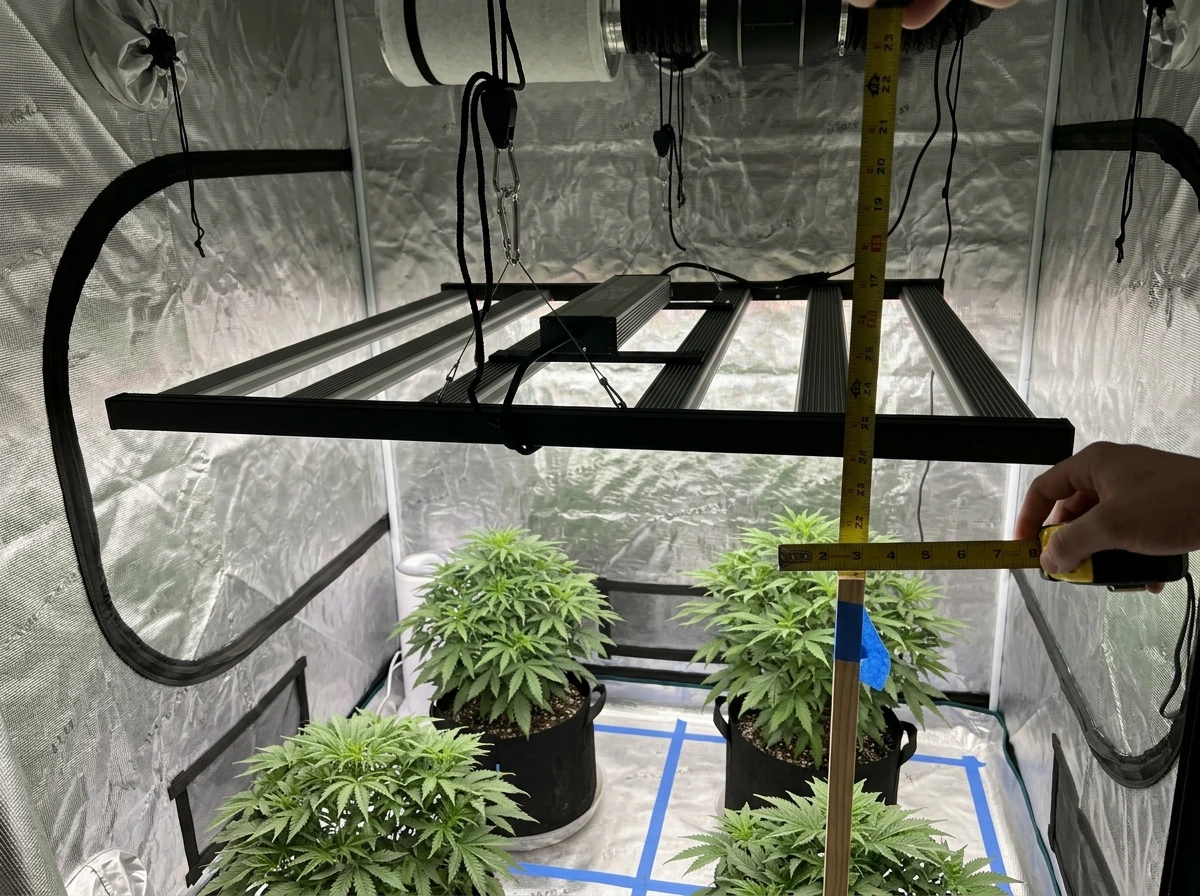
The manufacturer publishes specific hanging height and PPFD targets by plant stage, and these align well with the measured data.
| Plant Stage | Recommended Height | Target PPFD | Coverage Footprint |
|---|---|---|---|
| Seedling | 36"–48" | 200–300 µmol/m²/s | Up to 5'x5' |
| Vegetative | 24"–36" | 300–600 µmol/m²/s | 5'x5' |
| Flowering | 12"–36" | 600–1,500 µmol/m²/s | 4'x4' |
| Flowering (with CO₂) | 12"–36" | Up to 1,500 µmol/m²/s | 4'x4' |
The measured 1,182 µmol/m²/s average at 18 inches over a 4x4 is your benchmark for flowering. In practice, most growers running this light without CO2 should either raise it a few inches to soften the PPFD slightly, or dial the dimmer back to around 80 percent to land in the 900 to 1,000 µmol/m²/s range, which is the sweet spot for most strains. The 5x5 number of 777 µmol/m²/s at 18 inches is a good veg target and works fine for late-stage vegetative growth.
One real-world data point: a grower on Reddit reported pulling 24 oz (dry) from 5 autoflowers in a 4x4 tent using 80 percent output and a 20/4 light cycle. That's a strong yield number for autoflowers and speaks to the light's ability to drive production when dialed in correctly.
Power draw, efficiency, and heat
The ProGrow 1800 draws 673W at the wall (measured at 116V: 5.8A). It accepts a wide voltage range of 100 to 277V, so it'll run on standard 120V North American outlets without issue, and it can be hardwired to 240V in a more permanent installation. At 673W, it's a meaningful electrical load. On a standard 15A circuit, you're using roughly 46 percent of the circuit's capacity, which leaves comfortable headroom for fans and other accessories.
Heat output is rated at 2,295 BTU per hour. To put that in plain terms: it's significant, and if you're running this in a sealed tent without active exhaust, heat will be your limiting factor before light intensity is. Plan for at least 4-inch inline exhaust (6-inch is better) and monitor canopy temperature, especially in warmer months. The IP65 rating doesn't help with ambient heat management inside the tent, it just means the fixture itself is protected from humidity.
The fixture operates passively (no fans on the light itself), so noise is essentially zero from the light. Any noise in your grow space will come from your fans and inline exhaust, not the ProGrow 1800. This is a real quality-of-life advantage over older active-cooled LED fixtures.
Controls, dimming, and safety certifications
The driver on the ProGrow 1800 includes two 0-10V RJ-12 ports (one in, one out), which is the industry-standard interface for external dimming control. The fixture ships without a dimming knob, so if you want to adjust output you'll need to buy the ProGrow Dimmer separately. The Dimmer allows 0-100% output adjustment and can daisy-chain up to 3 ProGrow series fixtures using the included RJ12 cable, making it a practical addition for small multi-light setups.
For larger operations or for growers who want scheduling features, the ProGrow Lighting Controller steps things up considerably. It controls up to 50 ProGrow series lights, supports full 0-100% dimming, ON/OFF scheduling, and sunrise/sunset simulation via a programmable interface. It includes one 2-meter RJ12 cable and carries the same 5-year warranty as the fixture. Both the Dimmer and the Controller are brand-specific (they work with ProGrow series fixtures via RJ12 daisy-chain), so compatibility with third-party 0-10V systems should be confirmed before assuming universal compatibility, although the driver's 0-10V ports are an industry-standard interface.
On the safety and certification side: the ProGrow 1800 is ETL Certified to UL 8800 (the North American safety standard for horticultural lighting) and is DLC Listed, which means it's eligible for utility rebates in qualifying jurisdictions. These are not trivial credentials. ETL/UL 8800 certification means the fixture has been independently tested and verified to meet electrical safety requirements, which matters for insurance purposes in commercial grows and is good peace of mind for serious hobbyists. DLC listing adds practical financial value if your utility runs a rebate program.
How it compares to the alternatives
The ProGrow 1800 is listed at around $420, which puts it in a very competitive position for a 673W fixture with 2.7 µmol/J efficacy and strong certifications. Here's how it stacks up against the most relevant alternatives a grower in this space would consider.
| Fixture | True Draw | PPF (µmol/s) | Efficacy (µmol/J) | Footprint (Flower) | UV/FR Diodes | Approx. Price | Key Differentiator |
|---|---|---|---|---|---|---|---|
| Grow Light Science ProGrow 1800 | 673W | 1,821 | 2.7 | 4'x4' | No (some FR in whites) | $420 | ETL/DLC certified, IP65, wide voltage |
| Fluence SPYDR 2i | ~645W | ~1,700 | 2.6 | 4'x4' | No | $~800+ | Commercial pedigree, higher price |
| Gavita Pro 1700e LED | 645W | ~1,700 | 2.6 | 4'x4'–5'x5' | No | $~900+ | Industry-standard commercial bar light |
| Spider Farmer SE7000 | ~730W | ~1,820 | ~2.5 | 4'x5'–5'x5' | No | $~550–600 | Larger footprint coverage, slightly lower efficacy |
| Mars Hydro FC-E8000 | ~800W | ~2,016 | ~2.52 | 5'x5' | No | $~500–600 | Higher raw output, bigger footprint target |
At roughly $420, the ProGrow 1800 undercuts the Fluence SPYDR 2i and Gavita Pro 1700e by a significant margin while matching or beating them on efficacy. For more detail, see grow light mover reviews. That's its strongest argument. The Fluence and Gavita carry more commercial credibility and broader retailer support, but for a hobbyist growing in a single 4x4, the ProGrow 1800's output and certification credentials are hard to argue against at that price point. At roughly $420, the ProGrow 1800 undercuts the Fluence SPYDR 2i and Gavita Pro 1700e by a significant margin while matching or beating them on efficacy. That's its strongest argument. The Fluence and Gavita carry more commercial credibility and broader retailer support, but for a hobbyist growing in a single 4x4, the ProGrow 1800's output and certification credentials are hard to argue against at that price point. grow light reflector comparison
Against the Spider Farmer SE7000 and Mars Hydro FC-E8000, the ProGrow 1800 competes on value but offers a slightly smaller optimal footprint and better efficacy. If your space is a 5x5 flowering tent, the SE7000 or FC-E8000 may serve you better. If your flowering canopy is strictly 4x4, the ProGrow 1800 is the better match.
Who should buy it
- Hobbyist growers running a dedicated 4x4 flowering tent who want one fixture and don't want to manage multiple bars
- Growers in jurisdictions with utility rebate programs where DLC listing translates to real cost recovery
- Anyone who wants ETL/UL 8800 certification for safety or insurance reasons
- Growers who want to eventually scale to a multi-light controller setup (the RJ12 daisy-chain system scales well)
- Anyone who values passive cooling and silent operation in their grow room
Who should skip it
- Growers running a 5x5 or larger flowering canopy who need more even coverage than a 4x4 footprint light can provide
- Anyone prioritizing UV or dedicated far-red diodes as part of their spectrum strategy
- Growers on a tight budget who would benefit more from a well-reviewed 400-500W fixture in a 3x3 tent
- Anyone whose tent ceiling height limits them below 12 inches of hanging clearance in flower (light intensity at close range will be excessive)
Before you buy: what to check in your own space
Before ordering the ProGrow 1800, run through these practical checks to make sure it's the right fit for your specific setup.
- Measure your canopy area. If your flowering footprint is 4x4 or smaller, this fixture is well-matched. If it's 5x5, consider whether the 777 µmol/m²/s average at 18 inches is enough for your target strains, or whether a higher-output option would serve you better.
- Check your ceiling clearance. At 18 inches of hanging height over the canopy, you need enough vertical space above the plants for the fixture plus the ratchet hangers. In most 5-foot tents, this is manageable, but measure before assuming.
- Verify your circuit. The ProGrow 1800 draws 5.8A at 120V. On a 15A circuit, that's fine. On a shared circuit with a 6-inch inline fan and other loads, confirm you're not pushing above 80 percent of circuit capacity.
- Budget for the dimmer. The fixture ships without a dimming knob. At 1,182 µmol/m²/s average over a 4x4 at 18 inches, you'll almost certainly want to run it at 75 to 85 percent for most of flowering. The ProGrow Dimmer is a separate purchase.
- Check your utility for rebate eligibility. The DLC listing means you may be able to recover a meaningful portion of the purchase price through a utility rebate program, which effectively makes it even better value than the sticker price suggests.
If you've already reviewed other grow lights broadly and are narrowing down to this wattage class, the ProGrow 1800 is one of the more straightforward decisions in its price range. The specs are independently verified, the certifications are real, the PPFD numbers match what the manufacturer claims, and the real-world yield data from growers using it aligns with what you'd expect from a properly calibrated 673W fixture over a 4x4 canopy. It's not perfect, and it's not the only good option, but it delivers on its core promise at a price that's hard to beat in this class.
FAQ
Will the ProGrow 1800 fit a 4x4 tent with standard hanging rails, or do I need corner mounting?
Because the fixture is nearly the same width as a 4x4 opening (47 inches), it often won’t slide in comfortably on typical rail systems. Most users mount from corner anchor points or use external hanging rails, then fine-tune the distance to hit the published PPFD targets.
Is the 1800 number in “ProGrow 1800” a wattage rating?
No. The “1800” refers to the approximate PPF output (about 1,821 µmol/s), not the electrical draw. The measured power draw is about 673W at 116V, so your circuit planning should be based on wattage, not the model number.
Do I need a dimmer, or can I run the light at full output only?
The light ships without a dimming knob. It has RJ-12 0-10V control ports, so to adjust output you’ll need the brand’s ProGrow Dimmer (or the ProGrow Lighting Controller). Without that accessory, you’d be stuck at the default drive level.
How should I dial the dimmer if I’m not using CO2?
A common approach is to start around 80 to 85 percent output for flowering in a 4x4 when mounted at 18 inches, aiming to land roughly in the 900 to 1,000 µmol/m²/s range. If canopy heat climbs or plants stretch, adjust in 5 to 10 percent steps rather than jumping to full power.
What’s the biggest mistake when using PPFD numbers to plan a grow?
Most people confuse PPFD with total fixture output. PPFD depends on hanging height, reflectivity, and whether your tent walls stay reflective and clean. If you change height by even a couple inches, re-check your target PPFD and adjust dimming accordingly.
Can I mount the driver remotely, and is it required for good performance?
Remote mounting is optional, but it can be very helpful in a tight tent. Using the optional 10-foot DC extension cord lets you keep the driver outside the grow chamber, which improves heat management and helps maintain more stable canopy conditions.
If the driver fails, is it likely to be a defective unit?
Not necessarily. There’s at least one reported case of driver failure early on, but that pattern could be related to outlet power quality. A practical mitigation is to plug directly into a clean wall circuit (not a worn power strip), then run a short bench test before mounting inside a sealed tent.
Does the IP65 rating mean I don’t need to worry about humidity at all?
IP65 protects the fixture from moisture ingress to the electronics, it does not solve heat buildup. In other words, the light can tolerate humid environments, but you still need proper exhaust and airflow to control temperatures, since heat output is significant.
What exhaust size should I plan for given the heat output?
Plan on at least a 4-inch inline exhaust, with 6-inch preferable for strong heat removal. The key limiter is canopy temperature, not whether the fixture is waterproof. If your tent is sealed and the room is warm, you’ll likely hit a heat ceiling before you hit a light ceiling.
Will the ProGrow 1800 work well on 120V circuits in North America?
Yes. It accepts a wide voltage range (100 to 277V). At roughly 673W, it draws about 5.8A at 116V, which generally leaves comfortable headroom on a 15A circuit for typical fans and small accessories, but avoid sharing the circuit with high-load devices.
Is far-red or UV coverage sufficient for plants that benefit from it?
The fixture has no dedicated UV or far-red diodes. You may get some far-red contribution through the white diode spectrum, but if your cultivar responds strongly to far-red end-of-day signaling or you want UV exposure for trichome-related goals, plan on adding an external UV/FR supplement bar.
Can I use third-party 0-10V dimming equipment instead of the ProGrow Dimmer or Controller?
The driver includes industry-standard 0-10V RJ-12 ports, but the accessories are brand-specific in how they use the RJ-12 daisy-chain ecosystem. If you have third-party 0-10V hardware, confirm compatibility carefully, especially if you want multi-light daisy chaining.
Does the ProGrow 1800 run silently, or will my tent still be noisy?
The light itself is passively cooled, so it adds essentially no noise. In real setups, the noise you hear typically comes from your inline exhaust fan and any oscillating circulation fans, so your venting choice matters more than the fixture.
Is 18 inches the best hanging height for every stage and canopy density?
18 inches is a common reference point for reported PPFD results, but the manufacturer publishes stage-specific targets and growers often adjust height or dimming as canopies thicken. For example, late-flower density can create microclimate shading, so you may need slightly more height or slightly lower output to maintain consistent PPFD across the entire canopy.